A very early start to maximise time in the field saw me at Strumpshaw Fen RSPB reserve shortly after 7am. The purpose of the trip was to search for the larval cases of the UK BAP Priority moth Coleophora hydrolapathella. The larva feeds on Water Dock and the cases are fixed to the dead stems for pupation. There are no recent records from the Mid Yare Valley where Strumpshaw Fen is situated but as I was passing, I thought it worth a look. I walked all the way around the Fen Trail and the only reward was my first Swift of the year (what does that say about the Swift situation in Hampshire). I found very little Water Dock until the very end of the trail but there is a vast area of habitat that is not accessible to visitors.
Next stop was Alderfen Broad, a small Norfolk Wildlife Trust reserve where hydrolapathella was recorded in about 2000. I walked round the nature trail and eventually found a single larval case of the target species.
It was interesting to see that an area where the vegetation was cut in front of a viewing screen had abundant Water Dock so the cutting of further small areas around the Broad may well benefit the moth.
Walking back through the shelter of the wood and with occasional sunshine, I saw my first damselflies of the year and my first small swarm of the longhorn moth Adela reaumurella plus a reasonable selection of hoverflies. I was also pleased to see large amounts of Climbing Corydalis - ok so it's not rare but it was new for me!
Around the site were notices explaining about the large scale clearance of the non-native Red-berried Elder Sambuscus ramosus that had taken place. I could see no evidence of any clearance and the shrub was abundant so clearly something had gone wrong but it was of interest in that I had never even heard of this species, let alone come across it as a significant invasive.
My final port of call was another NWT reserve at Martham Broad. I could find no Water Dock here but the previous record of the moth was of an adult, rather than the larval case, so it may have wandered from the vast inaccessible areas of the reserve. By now the bitter wind had really picked up and all I saw of any note were a couple of Marsh Harriers quartering the marsh.
Welcome
Poor old Gilbert is getting restless. Despite the fact that there is more interest in wildlife than ever before, it seems that most of the so-called conservation organisations are losing interest in species. Instead they prefer to babble on about landscape scale conservation and ecosystem services (whatever they are). Could this be because most of their staff don't have any knowledge about species if they don't have four legs?
This is my attempt to encourage an interest in good old-fashioned natural history.
Friday, 24 May 2013
Friday, 17 May 2013
A day out east
Thanks to the elite of Sussex Pan-species listing for the invite to join them at Castle Hill NNR! One of the aims was to see Early Spider Orchid and we did manage to find one although we would have expected more.
Other interesting plants included Chalk Milkwort and Early Gentian. Apparently the latter is genetically identical to Autumn Gentian but it is distinct both in terms of morphology and flowering time so I'm not sure where that leaves us. Still, as I've never seen Autumn Gentian it was new for me whatever!
I also saw a number of new spiders, thanks to Graeme, and the nationally scarce ground beetle Licinus depressus but the highlight for me at Castle Hill was not actually a new species but the Dotted Bee-fly Bombylius discolor which Graeme managed to catch and then charm into posing for photos. My previous views of this species have always been fleeting glimpses before it shoots off, never to be seen again.
To round off a great afternoon we went to Shoreham fort where a Wall Lizard posed obligingly - my first non-avian vertebrate tick in years.
Other interesting plants included Chalk Milkwort and Early Gentian. Apparently the latter is genetically identical to Autumn Gentian but it is distinct both in terms of morphology and flowering time so I'm not sure where that leaves us. Still, as I've never seen Autumn Gentian it was new for me whatever!
I also saw a number of new spiders, thanks to Graeme, and the nationally scarce ground beetle Licinus depressus but the highlight for me at Castle Hill was not actually a new species but the Dotted Bee-fly Bombylius discolor which Graeme managed to catch and then charm into posing for photos. My previous views of this species have always been fleeting glimpses before it shoots off, never to be seen again.
To round off a great afternoon we went to Shoreham fort where a Wall Lizard posed obligingly - my first non-avian vertebrate tick in years.
Oak Processionary - a black week for conservation
On Tuesday of this week, the Forestry Commission carried out aerial spraying of a Site of Special Scientific Interest near Pangbourne in Berkshire with the insecticide Bacillus thuringiensis (Bt) in order to eliminate the Oak Processionary moth.
Why? The Oak Processionary is found in continental Europe and is thought to have been accidentally introduced into Britain in 2006 on imported trees. In Europe it occasionally causes defoliation of oak trees and the hairy caterpillars can induce an adverse reaction in some people. However, there are plenty of native moths that can cause defoliation (I have seen it several times where the 'culprits' have been Mottled Umber and Scarce Umber and the Green Oak Tortrix is well know for causing defoliation). So what about the health issues? The native Brown-tail moth causes the same problems and some people also suffer adverse reactions to a wide range of bites and stings. Do we hear of mass health problems in Europe within the Oak Processionary's native range? Of course not. People there are educated to avoid contact with the caterpillars, just as we are educated not to touch Stinging Nettles.
So has there been an outcry from conservation organisations about the aerial spraying of a broad-spectrum insecticide in an SSSI? Butterfly Conservation have criticised the action (see http://www.guardian.co.uk/environment/2013/may/06/pest-caterpillars-helicopter-blitz-insecticide ) but the local Wildlife Trust report that it is taking place on their web site without any comment and the RSPB appear to be silent on the matter. Why should the RSPB care? Because the use of Bt will kill all the caterpillars that insectivorous birds need to feed their young at the moment. What about Natural England? You should be astonished (but probably aren't if you know how useless they are these days) to hear that they voted IN FAVOUR of aerial spraying of an SSSI!
Aside from the damage caused to the Lepidoptera communities within this SSSI and the knock-on effect on everything that feeds on them, why do I object to the spraying? Firstly, because the caterpillars are gregarious and live in obvious nests which can be located and sprayed individually, as has been done throughout London. Secondly, the whole exercise is pointless! The response to finding Oak Processionary in London was too weak and too slow and even the Forestry Commission admit that the situation is now out of control in London. So if they've lost the battle in London and the moth continues to spread as rapidly as it has done, how long before it is back in Pangbourne (and everywhere else in southern England).
It is a sad indictment of conservation in Britain today that such activities can take place on our most important wildlife sites will hardly a murmour of opposition.
Why? The Oak Processionary is found in continental Europe and is thought to have been accidentally introduced into Britain in 2006 on imported trees. In Europe it occasionally causes defoliation of oak trees and the hairy caterpillars can induce an adverse reaction in some people. However, there are plenty of native moths that can cause defoliation (I have seen it several times where the 'culprits' have been Mottled Umber and Scarce Umber and the Green Oak Tortrix is well know for causing defoliation). So what about the health issues? The native Brown-tail moth causes the same problems and some people also suffer adverse reactions to a wide range of bites and stings. Do we hear of mass health problems in Europe within the Oak Processionary's native range? Of course not. People there are educated to avoid contact with the caterpillars, just as we are educated not to touch Stinging Nettles.
So has there been an outcry from conservation organisations about the aerial spraying of a broad-spectrum insecticide in an SSSI? Butterfly Conservation have criticised the action (see http://www.guardian.co.uk/environment/2013/may/06/pest-caterpillars-helicopter-blitz-insecticide ) but the local Wildlife Trust report that it is taking place on their web site without any comment and the RSPB appear to be silent on the matter. Why should the RSPB care? Because the use of Bt will kill all the caterpillars that insectivorous birds need to feed their young at the moment. What about Natural England? You should be astonished (but probably aren't if you know how useless they are these days) to hear that they voted IN FAVOUR of aerial spraying of an SSSI!
Aside from the damage caused to the Lepidoptera communities within this SSSI and the knock-on effect on everything that feeds on them, why do I object to the spraying? Firstly, because the caterpillars are gregarious and live in obvious nests which can be located and sprayed individually, as has been done throughout London. Secondly, the whole exercise is pointless! The response to finding Oak Processionary in London was too weak and too slow and even the Forestry Commission admit that the situation is now out of control in London. So if they've lost the battle in London and the moth continues to spread as rapidly as it has done, how long before it is back in Pangbourne (and everywhere else in southern England).
It is a sad indictment of conservation in Britain today that such activities can take place on our most important wildlife sites will hardly a murmour of opposition.
Tuesday, 14 May 2013
Early May
Before leaving Cumbria I had a look at Meathop Moss. There's been a lot of tree felling around the edges which has caused a fair mess. Ok so it needed doing in order to reduce the drying out of the bog but I was concerned by the virtually total destruction of the Bog Myrtle, larval foodplant for the UK BAP Argent & Sable moth which features prominently on the reserve sign. One would have thought that the felling and extraction could have been done with more care in at least part of the Bog Myrtle area. Time will tell whether the moth has survived. The only things of note seen were my first Green Hairstreaks of the year and Hair's-tail Cottongrass which was new for me.
On the way back I diverted into the Forest of Bowland to get a bit of a moorland fix, having missed out on going to the Highlands. Ok so it was a poor substitute but I did get to see my first Red Grouse for a number of years.
It was also good to see Oystercatchers displaying by the side of the road.
Back down south I finally ringed my first brood of three Woodlarks on 4th May. In 2012 I ringed 35 Woodlark nestlings in April - and that was hardly a good breeding season. Just shows how awfully delayed spring is this year.
On the way back I diverted into the Forest of Bowland to get a bit of a moorland fix, having missed out on going to the Highlands. Ok so it was a poor substitute but I did get to see my first Red Grouse for a number of years.
It was also good to see Oystercatchers displaying by the side of the road.
Back down south I finally ringed my first brood of three Woodlarks on 4th May. In 2012 I ringed 35 Woodlark nestlings in April - and that was hardly a good breeding season. Just shows how awfully delayed spring is this year.
Monday, 13 May 2013
Heading north
The weather throughout April remained awful so there was little to do but twitch a few more plants, probably the most notable being Alternate-leaved Golden Saxifrage
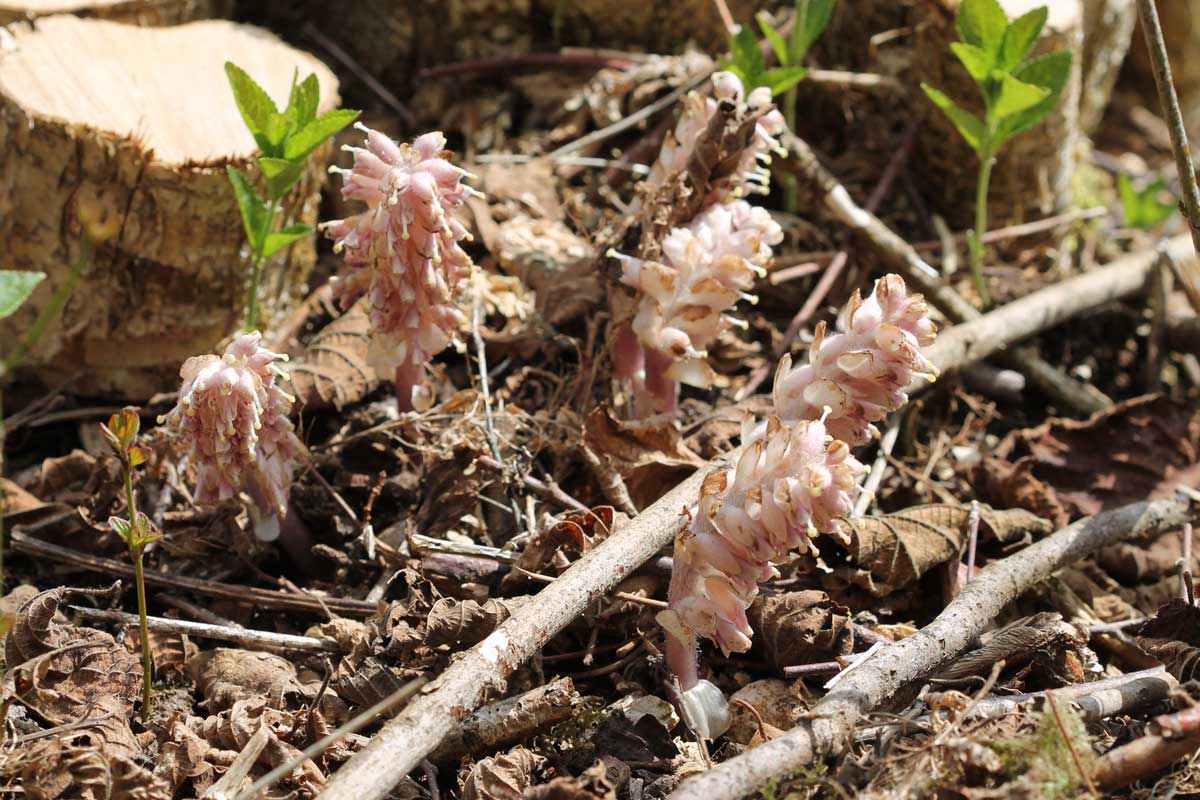
and several hundred flowering spikes of Toothwort in Sussex where Butterfly Conservation have carried out coppicing for Duke of Burgandy.
At the end of the month I was due to go to Cumbria for work and had a cunning plan to head up to the Highlands beforehand to get my first fix of the uplands for several years. Unfortunately my friend in Aviemore told me that the spring there was so delayed that there was little point going.
So I just headed for Cumbria to have a look at Butterfly Conservation's work to conserve High Brown and Pearl-bordered Fritillaries and Duke of Burgandy, together with the BAP moth Anania funebris, on the Morecambe Bay limestone. First visit was to Gait Barrows NNR where I had my first view of limestone pavement.
It's clearly a spectacular habitat but the late spring meant that I saw few species of note. I did see about 3mm of Lady's Slipper Orchid that have been planted there as part of a project with Kew Gardens. It all looked a bit plastic really, with the emerging shoots protected in copper rings and the patch surrounded with slug pellets! The most interesting thing was actually Common Gromwell. This years plants were not in flower but last years seeds were really impressive, looking like they were made of porcelain.
The following day we visited the Whitbarrow area; a truly spectacular landscape.
The scale of the work being carried out in the area is really impressive and, contrary to the usual position with 'landscape scale projects' there actually seems to be plans in place to continue the work beyond the life of the project.
I had hoped to see all sorts of interesting things but the cold spring meant that I had to limit myself to a few new grasses, sedges and ferns. Perhaps the best of the bunch was Blue Moor-grass which has a very limited distribution but is common at Whitbarrow.
and several hundred flowering spikes of Toothwort in Sussex where Butterfly Conservation have carried out coppicing for Duke of Burgandy.
At the end of the month I was due to go to Cumbria for work and had a cunning plan to head up to the Highlands beforehand to get my first fix of the uplands for several years. Unfortunately my friend in Aviemore told me that the spring there was so delayed that there was little point going.
So I just headed for Cumbria to have a look at Butterfly Conservation's work to conserve High Brown and Pearl-bordered Fritillaries and Duke of Burgandy, together with the BAP moth Anania funebris, on the Morecambe Bay limestone. First visit was to Gait Barrows NNR where I had my first view of limestone pavement.
It's clearly a spectacular habitat but the late spring meant that I saw few species of note. I did see about 3mm of Lady's Slipper Orchid that have been planted there as part of a project with Kew Gardens. It all looked a bit plastic really, with the emerging shoots protected in copper rings and the patch surrounded with slug pellets! The most interesting thing was actually Common Gromwell. This years plants were not in flower but last years seeds were really impressive, looking like they were made of porcelain.
The following day we visited the Whitbarrow area; a truly spectacular landscape.
The scale of the work being carried out in the area is really impressive and, contrary to the usual position with 'landscape scale projects' there actually seems to be plans in place to continue the work beyond the life of the project.
I had hoped to see all sorts of interesting things but the cold spring meant that I had to limit myself to a few new grasses, sedges and ferns. Perhaps the best of the bunch was Blue Moor-grass which has a very limited distribution but is common at Whitbarrow.
Thursday, 9 May 2013
Possibly the worst habitat management in the world
In early April I went to look at the Wild Tulips in Wiltshire. Unfortunately they were only in bud (and were still in bud two weeks later) but further down the lane I saw a new plant in the form of Asarabacca. There seems to be debate as to whether this is native or not but I did like the comment in one of my plant books 'a plant so dull that one wonders why it was ever planted'!
The following weekend I visited Woolbeding Common in West Sussex. Things started well with my first Cuckoo flying over soon after I left the car, lots of Linnets around and a Tree Pipit in song. But as I got down to the part of the common which was grazed last year I was just gobsmacked.
Last summer when I was there, an area had been electric fenced and cattle were grazing. There was hardly a scrap of edible vegetation left and I was tempted to phone the RSPCA out of concern for the cattles welfare. The only thing stopping me was that an adjacent area had been fenced and I assumed that the cattle were soon going to be moved into that area. The photograph below shows the area at that time.
The next photo shows the condition this spring of the adjacent area into which the cattle were moved.
On what planet is this appropriate habitat management? Can anyone guess why there are no Stonechats or Dartford Warblers around this year? The site is 'managed' by the National Trust so I could be accused of National Trust bashing - an increasingly popular sport in conservation circles. But it isn't that - they just happened to have provided a sufficiently extreme example that shows up reasonably well in photo's; I could provide examples of mis-management by virtually every other 'conservation' organisation.
Why is this happening (and, I believe, getting worse)? I believe it is because there are very few wardens these days who have an interest in, and therefore a knowledge of, wildlife. Universities don't teach students how to identify species and even if they did, the time available still wouldn't give students a comprehensive grounding - they need to want to look at wildlife in their own time. The trouble is that there is no incentive for them to do so because all employers are interested in is bits of paper and such nonsense as 'customer care skills'. I'm not kidding, a friend was interested in a job with Natural England last year and showed me their requirements. There were no questions about technical skills or knowledge but they did give you lots of room to describe your customer care skills. Luckily she either was intelligent enough not to apply or lucky enough not to get the job!
So what needs to be done? Well it will never happen but a solution would be for the person specifications for all jobs in conservation to be torn up and the following criteria applied:
1. For any role in nature conservation, the applicant must have a pan-species list of more than 1000, no more than 80% being in any one taxanomic group.
2. For a role having responsibility for the management of a SSSI, the applicant must have a pan-species list exceeding 2500, with no more than 50% being in any one taxanomic group.
I would like to set the targets higher but then there would be virtually no-one who could apply!
Why? Not because listing per se has any value whatsoever but if people have to see that many species they will actually have to spend time in the field and if they do that, they might actually learn something about what wildlife needs and then end up not trashing the reserves that they are the guardians of. One can but dream.......
Last summer when I was there, an area had been electric fenced and cattle were grazing. There was hardly a scrap of edible vegetation left and I was tempted to phone the RSPCA out of concern for the cattles welfare. The only thing stopping me was that an adjacent area had been fenced and I assumed that the cattle were soon going to be moved into that area. The photograph below shows the area at that time.
The next photo shows the condition this spring of the adjacent area into which the cattle were moved.
On what planet is this appropriate habitat management? Can anyone guess why there are no Stonechats or Dartford Warblers around this year? The site is 'managed' by the National Trust so I could be accused of National Trust bashing - an increasingly popular sport in conservation circles. But it isn't that - they just happened to have provided a sufficiently extreme example that shows up reasonably well in photo's; I could provide examples of mis-management by virtually every other 'conservation' organisation.
Why is this happening (and, I believe, getting worse)? I believe it is because there are very few wardens these days who have an interest in, and therefore a knowledge of, wildlife. Universities don't teach students how to identify species and even if they did, the time available still wouldn't give students a comprehensive grounding - they need to want to look at wildlife in their own time. The trouble is that there is no incentive for them to do so because all employers are interested in is bits of paper and such nonsense as 'customer care skills'. I'm not kidding, a friend was interested in a job with Natural England last year and showed me their requirements. There were no questions about technical skills or knowledge but they did give you lots of room to describe your customer care skills. Luckily she either was intelligent enough not to apply or lucky enough not to get the job!
So what needs to be done? Well it will never happen but a solution would be for the person specifications for all jobs in conservation to be torn up and the following criteria applied:
1. For any role in nature conservation, the applicant must have a pan-species list of more than 1000, no more than 80% being in any one taxanomic group.
2. For a role having responsibility for the management of a SSSI, the applicant must have a pan-species list exceeding 2500, with no more than 50% being in any one taxanomic group.
I would like to set the targets higher but then there would be virtually no-one who could apply!
Why? Not because listing per se has any value whatsoever but if people have to see that many species they will actually have to spend time in the field and if they do that, they might actually learn something about what wildlife needs and then end up not trashing the reserves that they are the guardians of. One can but dream.......
Tuesday, 7 May 2013
Playing catch up
Ok, I know I'm really bad at getting around to posting anything on this blog so I've decided that I should either write something regularly or just give up on the idea. I'll start by summarising the highlights of the year so far over the next few days.
The winter was fairly dull and went on far too long but a few things stick in the mind. One was a visit to Blashford Lakes where I managed to get a few half-decent shots of one of the Bitterns over the heads of the photographers who were hogging the only window in the hide that actually opens (as usual!).
I also saw my only Brambling of the winter - sadly it was a female.
The highlight for me though was managing to find the Eyelash Fungus at last. I had looked for it the previous winter and failed. If only all fungi were as distinctive as this one.
Given that I am generally avoiding twitching birds this year, and the winter was just going on forever, meaning that insects were non-existent, I have resorted to twitching a few plants. My first ever plant twitch was for Mezereon at Greywell. All the other local sites seem to be in woodland on the downs so it is rather strange that this colony is in Alder carr. Nevertheless, expert opinion deems the colony native.
On 1st April is was still cold and miserable with a biting wind so I headed over to a wood near Walderton on the Hants / West Sussex border where Green Hellebore was flowering:
Afterwards I went down to the coast where I failed to find any sign of a particular moth larva feeding on the Butterbur but I did find the non-native Giant Butterbur.
A few migrant Chiffchaffs had arrived but were completely silent and were foraging in the grass in the lee of any shelter they could find. I felt like joining them.
The remainder of April to follow tomorrow - hopefully.
The winter was fairly dull and went on far too long but a few things stick in the mind. One was a visit to Blashford Lakes where I managed to get a few half-decent shots of one of the Bitterns over the heads of the photographers who were hogging the only window in the hide that actually opens (as usual!).
I also saw my only Brambling of the winter - sadly it was a female.
The highlight for me though was managing to find the Eyelash Fungus at last. I had looked for it the previous winter and failed. If only all fungi were as distinctive as this one.
Given that I am generally avoiding twitching birds this year, and the winter was just going on forever, meaning that insects were non-existent, I have resorted to twitching a few plants. My first ever plant twitch was for Mezereon at Greywell. All the other local sites seem to be in woodland on the downs so it is rather strange that this colony is in Alder carr. Nevertheless, expert opinion deems the colony native.
On 1st April is was still cold and miserable with a biting wind so I headed over to a wood near Walderton on the Hants / West Sussex border where Green Hellebore was flowering:
Afterwards I went down to the coast where I failed to find any sign of a particular moth larva feeding on the Butterbur but I did find the non-native Giant Butterbur.
A few migrant Chiffchaffs had arrived but were completely silent and were foraging in the grass in the lee of any shelter they could find. I felt like joining them.
The remainder of April to follow tomorrow - hopefully.
Subscribe to:
Posts (Atom)